
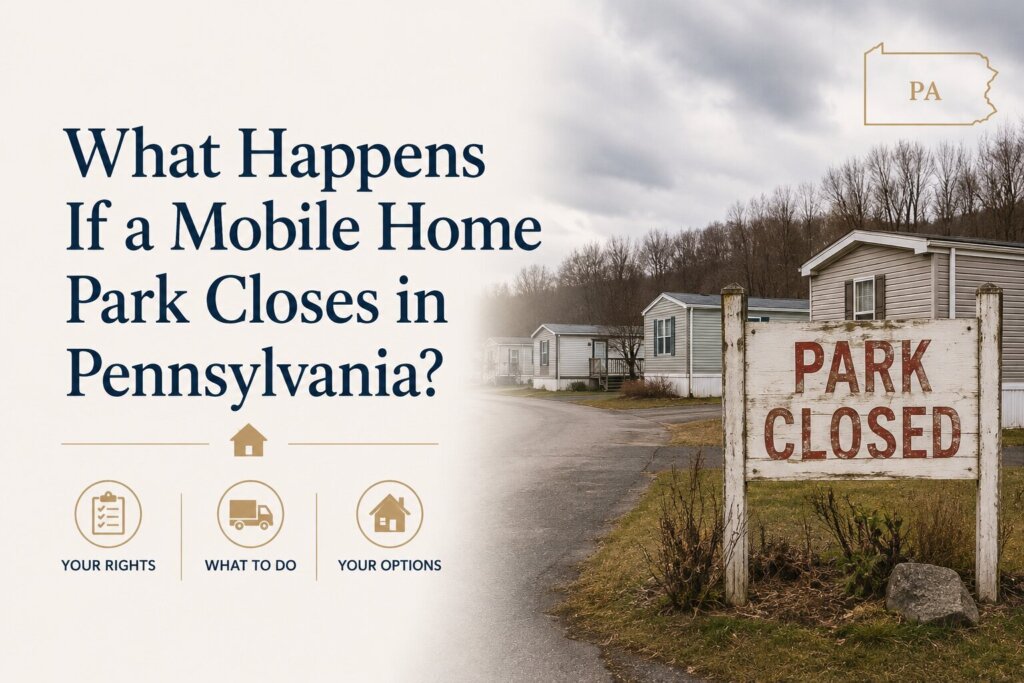
If you just got a notice that your manufactured home community is closing, you’re probably wondering three things: how much time you actually have, whether the park owner owes you anything, and what your options are for your home itself. Here’s what Pennsylvania law actually requires, and where selling your home outright can fit into the picture.
Under Pennsylvania’s Manufactured Home Community Rights Act, a park owner must give residents written notice at least 180 days before they’re expected to vacate, notify several government bodies in addition to residents, and pay each homeowner a set relocation allowance. You are not required to move your home on the timeline the park prefers, you can also choose to sell it, either before the closure takes effect or as part of winding down your stay.
Sell Your Mobile or Manufactured Home On Your Terms
Does Pennsylvania Law Actually Protect You When a Park Closes?
Yes. Manufactured home communities with three or more homes are covered by the Manufactured Home Community Rights Act (68 P.S. § 398.1, et seq., originally Act 261 of 1976, substantially amended by Act 156 of 2012). This law exists specifically because mobile and manufactured homes are expensive and difficult to relocate, so Pennsylvania built in notice periods and financial protections that don’t exist for most other types of rental housing.
The law applies whether you own your home outright and simply rent the lot, or you’re still paying it off, as long as you’re not renting the home itself from someone else (renters of the home, rather than owners of the home, fall under the separate Landlord and Tenant Act instead).
How Much Notice Must a Park Give Before Closing?
A community owner who decides to close all or part of a park must:
- Send written notice to residents, the resident association (if one exists), the Pennsylvania Housing Finance Agency (PHFA), and the local municipality, within 60 days of deciding to close.
- Include an estimated closure date in that notice.
- Give residents an estimated move-out date that is at least 180 days after the date of the notice.
In practice, that means you’re entitled to roughly six months from the day you receive notice before you have to be out, even though the “decision to close” itself may have been made earlier. If a park is being sold or leased rather than closed outright, a separate notice must go out to residents and PHFA within 30 days of the sale agreement being signed.
If a notice you’ve received doesn’t include these elements, or arrived with less lead time than the law requires, that’s worth flagging to an attorney or the state before you assume the shorter deadline is enforceable.
Are You Owed Money for Relocation?
Yes, and the amount is set by statute, not left to negotiation. Pennsylvania law requires the community owner to pay each homeowner relocation costs, up to a capped amount that adjusts annually for inflation. As of the most recent adjustment, the caps are:
- Up to $4,543.72 for a single-section manufactured home
- Up to $6,815.58 for a multi-section (double-wide or larger) manufactured home
These figures are recalculated each year by the state’s Department of Community and Economic Development to track the Consumer Price Index, so always confirm the current-year amount rather than relying on a number you saw in an old notice or blog post.
It’s worth noting what this payment is actually meant to cover: the physical cost of moving the home to a new location. If your plan isn’t to move the home at all, because it’s older, in poor condition, or just not cost-effective to relocate, that relocation payment may not come close to what you’d need, which is exactly the situation where selling the home outright, rather than moving it, tends to make more financial sense.
Can You Sell Your Home Instead of Moving It?
Yes, and for a lot of homeowners facing a closure notice, this is the more realistic path. You generally have three options once a closure notice is issued:
- Move the home to a new lot or community, using your relocation payment toward the cost, understanding that older or larger homes are often difficult or too costly to move safely.
- Sell the home in place before the community fully closes, to a buyer who will either move it themselves or negotiate directly with the incoming property owner.
- Sell the home for cash to a direct buyer and walk away with money in hand instead of managing a move, a for-sale listing, or a teardown on a deadline.
The 180-day notice period is exactly the kind of runway you need to sell on your own terms rather than being forced into a rushed, distress sale as the deadline closes in. Waiting until the last few weeks tends to shrink your options and your leverage, most manufactured home buyers, cash or otherwise, need at least a few weeks to evaluate the home, confirm title status, and schedule closing.
What If the Park Is Sold to a New Owner Instead of Closing?
A closure isn’t the only scenario. If the community is being sold or leased to a new operator, the current owner must send written notice to residents and PHFA within 30 days of signing the sale agreement. A change in ownership doesn’t automatically mean residents have to leave, but it’s worth watching closely, since a new owner may pursue closure or redevelopment down the line. The same notice-and-relocation protections apply if that owner later decides to close the community.
Do Residents Have the Right to Buy the Park Themselves?
Pennsylvania law gives residents the opportunity to organize and make an offer to purchase the community before a sale to an outside buyer is finalized, and the owner is required to negotiate with an organized resident group in good faith. In practice, this is a heavy lift, it requires the majority of residents to organize, secure financing, and move quickly within the process timeline, but it’s a legal option worth knowing about if your community is large enough and residents are motivated to pursue it.
What If the Park Owner Doesn’t Follow the Law?
If you believe a community owner skipped a required notice, missed a deadline, or hasn’t paid the relocation amount they owe, you have two main avenues:
- File a complaint with your local District Attorney.
- File a complaint with the Pennsylvania Office of Attorney General’s Bureau of Consumer Protection, either online or by calling the Consumer Protection Hotline at 1-800-441-2555.
Keep copies of every notice you receive and the date you received it, that paper trail matters if you ever need to show the timeline didn’t meet the legal minimum.
Frequently Asked Questions
How much notice is required before a mobile home park closes in Pennsylvania?
At least 180 days between the date of the official closure notice and your expected move-out date, in addition to earlier notice sent to PHFA and your municipality within 60 days of the owner’s decision to close.
How much relocation money am I owed if my PA mobile home park closes?
Up to $4,543.72 for a single-section home or $6,815.58 for a multi-section home, under the current statutory cap, which is adjusted annually for inflation.
Can a mobile home park in Pennsylvania evict me without a reason?
No. Under the Manufactured Home Community Rights Act, you can only be required to leave for nonpayment of rent, repeated rule violations within a six-month period, or a change in use or closure of the community, and each of those has its own required notice process.
Is it better to move my mobile home or sell it if the park is closing?
It depends on the home’s age, condition, and the cost of moving it versus what it could sell for as-is. Homes that are older, larger, or in a park too far from an available new lot are often more cost-effective to sell than to relocate, the statutory relocation payment is meant to offset moving costs, not necessarily replace the value of the home.
Who do I contact if my park owner isn’t following Pennsylvania’s closure notice law?
Your local District Attorney or the PA Attorney General’s Bureau of Consumer Protection (1-800-441-2555).
This article explains Pennsylvania’s Manufactured Home Community Rights Act (68 P.S. § 398.1, et seq.) in general terms and isn’t a substitute for legal advice. If you’re facing a closure notice, consider confirming the current relocation-payment cap and your specific rights with the PA Attorney General’s Bureau of Consumer Protection or a licensed attorney.
Facing a park closure and thinking about selling instead of moving?